Thursday, April 15, 2010

Coleridge - strays from the traditional...


Sarah – with an “h” is the traditional spelling and its origin is Hebrew meaning princess. However Coleridge speaks of a Sara without an “h” perhaps he left off the “h” by mere accident but I highly doubt this is the case. So then why would he stray from the biblical spelling?

In the opening of the ballad, Effusion XXIII: To the Nightingale, Coleridge addresses the “sister of love- lorn poets Philomel”! Philomel comes from the name Philomela the princess of Athens. Long story short - both Philomela and her sister were turned into birds specifically Philomela into a nightingale – hence the nightingale being called Philomel.

This background information is rather important since Coleridge does hear the call of the Nightingale which in turn inspires his “phantasies”. Perhaps he believes the bird pictured to the above to be the call of the ancient princess. Although Sara is the best belov’d of human kind, Coleridge wants to go back into nature and listen to the sweet melancholy song of the Nightingale. This may explain why the “h” is left off in the spelling of Sarah – because she is not as alluring as the Nightingale and not a true princess like the soul of Philomela. As we find out in the end of the ballad however, Sara is a real woman who will soon take Coleridge's last name but the superstition still remains - Sara with out an "h" has a more wild and superstitious appeal connecting to the world of fantasies drawing Coleridge to her.

Wednesday, April 7, 2010

Give up on your pride...

Pride – yet another deadly sin…

In Lines left upon a Seat in a Yew-Tree a stranger tells us of a kind of man whose soul was fed and sustained on pride. The very man who taught the tree how to bend its arms in circling shade; the same man who looks down on the world, and humanity, with mournful joy because of its loveliness. The stranger tells us a story of a man who seems to be oppressed through his own prideful life who died and left the Earth the Yew-Tree seat his only monument.

Pride stops us from seeing the real beauty of nature for we become entrenched in our own lives and forget the serenity of the world. Wordworth warns us of the power of pride and that “true knowledge leads to love”. True knowledge lies in the aesthetic values in life, in appreciating the natural world for its vast beauty and understanding nature’s intrinsic value. But when we become consumed with our own abilities sin can quickly overtake aesthetic values.

The lyrics of Pride by Syntax seem to reinforce the same message of Wordsworth “don’t hide, shine a light, give up on your pride…” If one is not careful with their pride it will shroud the fact that life is beautiful and nature is aesthetic.

Thursday, April 1, 2010

Envious Opression

Envy – it is one of the seven deadly sins also known as the Cardinal Sins. The Christian church uses the Cardinal Sins to instruct its followers about “fallen humanity’s tendency to sin”. Sonnet XLIV written by Charlotte Smith is full of envy towards the dead bodies being battered in the oceans surf. The bodies no longer hear the warring elements but as for Miss Smith – she is doomed by an oppressive lifelong storm. It is therefore not surprising that she is envious and wishes she could be free and gazes with envy on their gloomy rest.

Charlotte Smith is oppressed by life and her inability to control her emotions. She longs to be part of the Earth again like the dead bodies although this thought itself is oppressing. It can be argued that envy can lead towards a life of oppression as it did for Miss Smith. Sonnet forty four is filled with melancholy emotions but the cause of envy is not revealed until the end. Perhaps if Charlotte Smith stopped being so envious her overall tone would be different. Yes, she lived a hard life but her works of literature could portray an optimistic look into nature. It was not until I read this Sonnet of hers that I believed that the cause of such oppression was in fact her envious view of the freed dead.

The picture below is a some what comical view of envy. The big green dog represents Charlotte Smith who has a life, and yet is envious of the smaller dog who has a bone, the dead floating bodies!

Tuesday, March 23, 2010

A Delusive Art

A delusive art is what Charlotte Smith defines the game of a muse in Sonnet I. Therefore it is not surprising that the tone of the poem is overcast by a delusive and melancholy state as well. The Old English Dictionary defines delude as “to frustrate the aim or purpose of….” And the muse does exactly this – she confuses our feelings between friendship and unhappy love, between serenity and turmoil. But there must be more than just the muse on the surface.

As I read the sonnet over and over again I could not escape the idea of the muse representing the wildness of nature and its delusive state as well. Nature tricks us and frustrates us in the same way as a muse. It is pristine and beautiful and yet can be destructive and horrific without any notice. Nature tempts us and frustrates us but we would not be able to survive without the natural world and its elements.

Charlotte Smith notes that - those who never learn of the muse’s delusive art
will be much happier. However this is also true in the representation of the wildness of nature. Those who turn a blind eye to the destructive beauty of nature are likely to be happier than those who have experienced firsthand the power and mockery of natural disasters. The picture below demonstrates the muse of nature – beautiful but destructive… a delusive art.


Top Left: Land before Hurricane Katrina
Bottom Left: Land after Hurricane Katrina
Right: The Delusive Art of the Nature

Tuesday, March 16, 2010

A Purple Orgasm?

In the sonnet “On Seeing Miss Helen Maria Williams Weep at a Tale of Distress” the color purple is representative of the blood flowing through Wordsworth veins. The pumping of Wordsworth is a direct consequence of seeing Miss Helen cry. Purple is not only a symbolism of royalty as we typically assume, but it is also the combination of red and blue. Red is symbolic of strong emotions and blue is symbolic of the human emotion of sadness; the combination of these two colors express the sentimental tone of the poem.

In the last half of the poem the two colors of red and blue seem to collide again although purple is only mentioned in the first line of the sonnet. “Dear was the pause of life…” can be interpreted as a sexual orgasm – and as we all know and orgasm is filled with strong emotions from both participating parties and the human emotion of sadness when the pleasure is over. The two emotions combined create the color purple which we originally examined, for intensely flowing blood is needed for an orgasm. The idea of two colors uniting and being representative of an orgasm seems rather abstract but can be represented by the painting below.


Wednesday, March 3, 2010

Symbolism of Five?

For five years Wordsworth travels about and writing his ballads and for five years he has not seen the very spot in which he stands. “Tintern Abbey” is about returning to a town after a five year exclusion into nature and the collision of past and present thoughts.

Yes – the number five represents the actual years Wordsworth has been gone. But as I have learned there is always a deeper more “wild” meaning to the words that Wordsworth puts to the page. The number five symbolizes human life, and for Wordsworth his life has been drastically altered by his experiences in the past 5 years. He understands the difference between escaping what he dreads and following what he loves. This ballad is a type of autobiography of his life in a mere 160 sixty lines.

As Wordsworth is looking down onto the town there seems to be a picturesque balance between the babbling stream, cottages, grand old cypress and pastoral farms. In the town there is balance between the natural world and society, and he seems to be greatly satisfied with his place in the midst of it all.
The harmonious balance reminded me of another symbolism of five in the Wheel of Being used in both Celtic and Druid societies. It represents the four powers or elements united by a fifth... balance in all.

The symbolism of five only strengthens Wordsworth’s ballad and I believe it was no mere accident.


The five fold pattern of the Wheel of Being with the middle representing balance!


Wednesday, February 24, 2010

The Suffering of a Sick Soul

The lamb is often representative of suffering and sacrifice which is also true in the ballad The Last of the Flock written by Wordsworth. The narrator is first depicted with the lamb in his arms as he begins to tell his tale. After the Sheppard tells his life story of the sheep, focusing solely on his herd and how it grew from a single lamb, the man is inevitably left with only one lamb. The story – a complete circle, of suffering and sacrifice. The Sheppard bases his whole existence on the sheep, the more sheep he had, the more love he had and in the end he is left with neither sheep nor love.

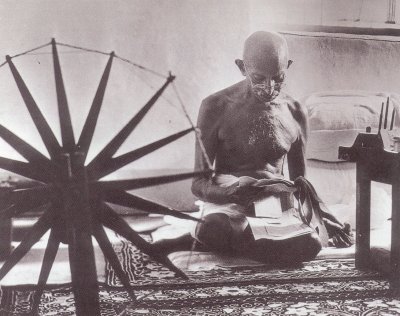
The question must be asked – can love really come from owning property such as the sheep? Mohandas Gandhi would argue that the Sheppard suffers not because he has to sacrifice his sheep for bread, but because he has a sick soul. We as human beings are on a fruitless drive, for something to satisfy the appetite of our hungry empty souls, and until we stop this cycle – we will not stop the suffering. From the context of the ballad we can infer that the Sheppard is poor, but he does have a house a wife and children. The Sheppard creates his own suffering by yearning for things that will bring him money instead of being satisfied with the simple life. Unlike the Sheppard, Gandhi was able to rid him self of selfless wants and live the simple life.